学术相关
SkillAdaptor: Self-adapting skills for LLM agents from trajectories 1
We propose SkillAdaptor, a training-free step-level skill adaptation framework with explicit failure attribution, and it can plug into OpenClaw-class agent harnesses.
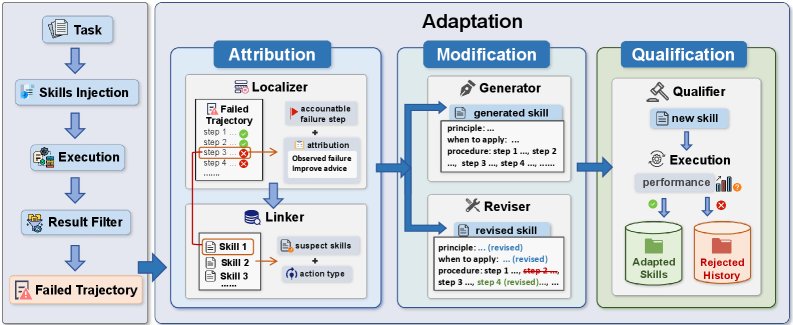
- outcome-level的进行在long-horizon environments中通常失败
- 提出trajectory-level reflection
轨迹$\tau={(a_t, o_t)}^T_{t=1}$其中$a_t$为智能体动作,$o_t$为观察
技能集$K$
- Attribution
- 定位到最早可导致失败步骤
- Linker 评估最有关联的skill(评估权重)
- Modification
- GENERATE:生成新skill
- 语义筛选:避免与已有skill过于相似,减少skill膨胀
- REVISE:重写最高权重skill
- GENERATE:生成新skill
- Qualification
- 测试修改skill的收益
Limitations: the method is most effective when failures expose observable intermediate signals and required tool dependencies are available, and its performance may weaken under sparse, delayed feedback or missing external interfaces.
这个限制太强了,设计得非常理想化,在实操中感觉成本高、作用不大,很多失败是模糊的,定位是最难的环节,改进通常也不会有明确的方向
Personalized Deep Research: A User-Centric Framework, Dataset, and Hybrid Evaluation for Knowledge Discovery 2
Current systems fail to adaptively adjust the depth and breadth of exploration based on the user’s existing expertise or latent interests, frequently resulting in reports that are either redundant for experts or overly dense for novices.
Rather than treating personalization as a post-hoc formatting step, PDR unifies user profile modeling with iterative query development, dual-stage (private/public) retrieval, and context-aware synthesis.
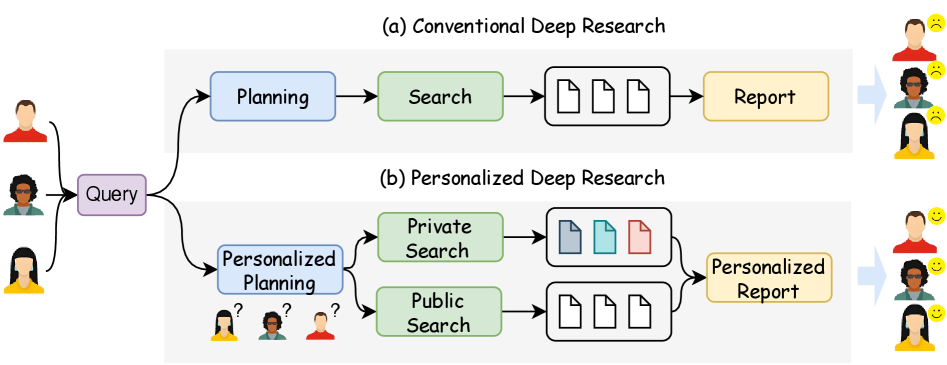
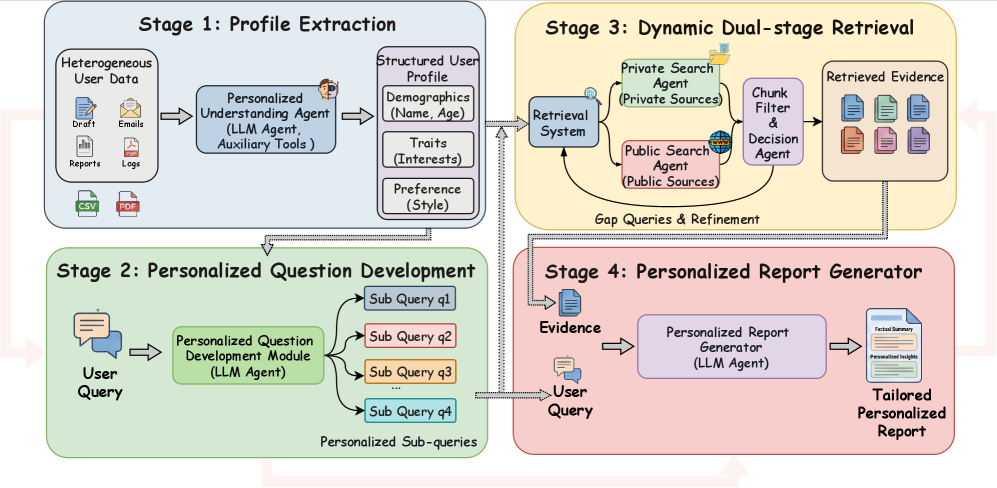
在深度研究中添加taste因素这个观点很重要,但是对于质量的评估指标不够有效,在深度检索领域,基于我个人的经验LLM-as-Judge具有很多局限性
-
Yu, Z., Xie, X., Yao, W., Wang, C., Liang, L., Qi, X., & Deng, S. (2026). SkillAdaptor: Self-adapting skills for LLM agents from trajectories(Version 1). arXiv. https://doi.org/10.48550/ARXIV.2606.01311 ↩
-
Li, X., Zhang, W., Zhang, Y., Jia, P., Wang, Y., Wang, Y., Liu, Y., Guo, H., & Zhao, X. (2026). Personalized deep research: A user-centric framework, dataset, and hybrid evaluation for knowledge discovery (arXiv:2605.10530). arXiv. https://doi.org/10.48550/arXiv.2605.10530 ↩